RIZAL'S RETRACTION
Introduction
This section presents contrasting views on the retraction by biographers of Rizal. The team deemed it proper to present the views in the exact words of the scholars so as to avoid misinterpretations.
Read on and judge for yourself whether Rizal retracted or not.
Texts of Rizal's Retraction
The "original" discovered by Fr. Manuel Garcia, C.M. on May 18, 1935
Me declaro catolica y en esta Religion en que naci y me eduque quiero vivir y morir.
Me retracto de todo corazon de cuanto en mis palabras, escritos, inpresos y conducta ha habido contrario a mi cualidad de hijo de la Iglesia Catolica. Creo y profeso cuanto ella enseña y me somento a cuanto ella manda. Abomino de la Masonaria, como enigma que es de la Iglesia, y como Sociedad prohibida por la Iglesia. Puede el Prelado Diocesano, como Autoridad Superior Eclesiastica hacer publica esta manifastacion espontanea mia para reparar el escandalo que mis actos hayan podido causar y para que Dios y los hombers me perdonen.
Manila 29 de Deciembre de 1896
Jose Rizal
Jefe del Piquete
Juan del Fresno
Ayudante de Plaza
Eloy Moure
Translation (English)
I declare myself a catholic and in this Religion in which I was born and educated I wish to live and die.
I retract with all my heart whatever in my words, writings, publications and conduct has been contrary to my character as son of the Catholic Church. I believe and I confess whatever she teaches and I submit to whatever she demands. I abominate Masonry, as the enemy which is of the Church, and as a Society prohibited by the Church. The Diocesan Prelate may, as the Superior Ecclesiastical Authority, make public this spontaneous manifestation of mine in order to repair the scandal which my acts may have caused and so that God and people may pardon me.
Manila 29 of December of 1896
Jose Rizal
La Voz Española, December 30, 1896
Me declaro catolica y en esta Religion en que naci y me eduque quiero vivir y morir.
Me retracto de todo corazon de cuanto en mis palabras, escritos, inpresos y conducta ha habido contrario a mis cualidades de hijo de la Iglesia Catolica. Creo y profeso cuanto ella enseña y me somento a cuanto ella manda. Abomino de la Masonaria, como enigma que es de la Iglesia y como sociedad prohibida por la Iglesia. Puede el Prelado Diocesano, como autoridad superior eclesiastica hacer publica esta manifastacion espontanea para reparar el escandalo que mis actos hayan podido causar y para que Dios y los hombers me perdonen.
Manila, 29 de Diciembre de
1896-Jose Rizal
Jefe del Piquete
Juan del Fresno
Ayudante de Plaza
Eloy Moure
Fr. Balaguer's text, January 1897
Me declaro catolica y en esta Religion en que naci y me eduque quiero vivir y morir. Me retracto de todo corazon de cuanto en mis palabras, escritos, inpresos y conducta ha habido contrario a mi calidad de hijo de la Iglesia. Creo y profeso cuanto ella enseña y me somento a cuanto Ella manda. Abomino de la Masonaria, como enigma que es de la Iglesia, y como Sociedad prohibida por la misma Iglesia.
Puede el Prelado diocesano, como Autoridad superior eclesiastica hacer publica esta manifastacion espontanea mia, para reparar el escandalo que mis actos hayan podido causar, y para que Dios y los hombers me perdonen.
Manila, 29 de Diciembre de
1896-Jose Rizal
ANALYSIS OF RIZAL'S RETRACTION
At least four texts of Rizal’s retraction have surfaced. The fourth text appeared in El Imparcial on the day after Rizal’s execution; it is the short formula of the retraction.
The first text was published in La Voz Española and Diaro de Manila on the very day of Rizal’s execution, Dec. 30, 1896. The second text appeared in Barcelona, Spain, on February 14, 1897, in the fortnightly magazine in La Juventud; it came from an anonymous writer who revealed himself fourteen years later as Fr. Balaguer. The "original" text was discovered in the archdiocesan archives on May 18, 1935, after it disappeared for thirty-nine years from the afternoon of the day when Rizal was shot.
We know not that reproductions of the lost original had been made by a copyist who could imitate Rizal’s handwriting. This fact is revealed by Fr. Balaguer himself who, in his letter to his former superior Fr. Pio Pi in 1910, said that he had received "an exact copy of the retraction written and signed by Rizal. The handwriting of this copy I don’t know nor do I remember whose it is. . ." He proceeded: "I even suspect that it might have been written by Rizal himself. I am sending it to you that you may . . . verify whether it might be of Rizal himself . . . ." Fr. Pi was not able to verify it in his sworn statement.
This "exact" copy had been received by Fr. Balaguer in the evening immediately preceding Rizal’s execution, Rizal y su Obra, and was followed by Sr. W. Retana in his biography of Rizal, Vida y Escritos del Jose Rizal with the addition of the names of the witnesses taken from the texts of the retraction in the Manila newspapers. Fr. Pi’s copy of Rizal’s retraction has the same text as that of Fr. Balaguer’s "exact" copy but follows the paragraphing of the texts of Rizal’s retraction in the Manila newspapers.
Regarding the "original" text, no one claimed to have seen it, except the publishers of La Voz Espanola. That newspaper reported: "Still more; we have seen and read his (Rizal’s) own hand-written retraction which he sent to our dear and venerable Archbishop…" On the other hand, Manila pharmacist F. Stahl wrote in a letter: "besides, nobody has seen this written declaration, in spite of the fact that quite a number of people would want to see it. "For example, not only Rizal’s family but also the correspondents in Manila of the newspapers in Madrid, Don Manuel Alhama of El Imparcial and Sr. Santiago Mataix of El Heraldo, were not able to see the hand-written retraction.
Neither Fr. Pi nor His Grace the Archbishop ascertained whether Rizal himself was the one who wrote and signed the retraction. (Ascertaining the document was necessary because it was possible for one who could imitate Rizal’s handwriting aforesaid holograph; and keeping a copy of the same for our archives, I myself delivered it personally that the same morning to His Grace Archbishop… His Grace testified: At once the undersigned entrusted this holograph to Rev. Thomas Gonzales Feijoo, secretary of the Chancery." After that, the documents could not be seen by those who wanted to examine it and was finally considered lost after efforts to look for it proved futile.
On May 18, 1935, the lost "original" document of Rizal’s retraction was discovered by the archdeocean archivist Fr. Manuel Garcia, C.M. The discovery, instead of ending doubts about Rizal’s retraction, has in fact encouraged it because the newly discovered text retraction differs significantly from the text found in the Jesuits’ and the Archbishop’s copies. And, the fact that the texts of the retraction which appeared in the Manila newspapers could be shown to be the exact copies of the "original" but only imitations of it. This means that the friars who controlled the press in Manila (for example, La Voz Española) had the "original" while the Jesuits had only the imitations.
We now proceed to show the significant differences between the "original" and the Manila newspapers texts of the retraction on the one hand and the text s of the copies of Fr. Balaguer and F5r. Pio Pi on the other hand.
First, instead of the words "mi cualidad" (with "u") which appear in the original and the newspaper texts, the Jesuits’ copies have "mi calidad" (without "u").
Second, the Jesuits’ copies of the retraction omit the word "Catolica" after the first "Iglesias" which are found in the original and the newspaper texts.
Third, the Jesuits’ copies of the retraction add before the third "Iglesias" the word "misma" which is not found in the original and the newspaper texts of the retraction.
Fourth, with regards to paragraphing which immediately strikes the eye of the critical reader, Fr. Balaguer’s text does not begin the second paragraph until the fifth sentences while the original and the newspaper copies start the second paragraph immediately with the second sentences.
Fifth, whereas the texts of the retraction in the original and in the manila newspapers have only four commas, the text of Fr. Balaguer’s copy has eleven commas.
Sixth, the most important of all, Fr. Balaguer’s copy did not have the names of the witnesses from the texts of the newspapers in Manila.
In his notarized testimony twenty years later, Fr. Balaguer finally named the witnesses. He said "This . . .retraction was signed together with Dr. Rizal by Señor Fresno, Chief of the Picket, and Señor Moure, Adjutant of the Plaza." However, the proceeding quotation only proves itself to be an addition to the original. Moreover, in his letter to Fr. Pi in 1910, Fr. Balaguer said that he had the "exact" copy of the retraction, which was signed by Rizal, but her made no mention of the witnesses. In his accounts too, no witnesses signed the retraction.
How did Fr. Balaguer obtain his copy of Rizal’s retraction? Fr. Balaguer never alluded to having himself made a copy of the retraction although he claimed that the Archbishop prepared a long formula of the retraction and Fr. Pi a short formula. In Fr. Balaguer’s earliest account, it is not yet clear whether Fr. Balaguer was using the long formula of nor no formula in dictating to Rizal what to write. According to Fr. Pi, in his own account of Rizal’s conversion in 1909, Fr. Balaguer dictated from Fr. Pi’s short formula previously approved by the Archbishop. In his letter to Fr. Pi in 1910, Fr. Balaguer admitted that he dictated to Rizal the short formula prepared by Fr. Pi; however; he contradicts himself when he revealed that the "exact" copy came from the Archbishop. The only copy, which Fr. Balaguer wrote, is the one that appeared ion his earliest account of Rizal’s retraction.
Where did Fr. Balaguer’s "exact" copy come from? We do not need long arguments to answer this question, because Fr. Balaguer himself has unwittingly answered this question. He said in his letter to Fr. Pi in 1910:
"…I preserved in my keeping and am sending to you the original texts of the two formulas of retraction, which they (You) gave me; that from you and that of the Archbishop, and the first with the changes which they (that is, you) made; and the other the exact copy of the retraction written and signed by Rizal. The handwriting of this copy I don’t know nor do I remember whose it is, and I even suspect that it might have been written by Rizal himself."
In his own word quoted above, Fr. Balaguer said that he received two original texts of the retraction. The first, which came from Fr. Pi, contained "the changes which You (Fr. Pi) made"; the other, which is "that of the Archbishop" was "the exact copy of the retraction written and signed by Rizal" (underscoring supplied). Fr. Balaguer said that the "exact copy" was "written and signed by Rizal" but he did not say "written and signed by Rizal and himself" (the absence of the reflexive pronoun "himself" could mean that another person-the copyist-did not). He only "suspected" that "Rizal himself" much as Fr. Balaguer did "not know nor ... remember" whose handwriting it was.
Thus, according to Fr. Balaguer, the "exact copy" came from the Archbishop! He called it "exact" because, not having seen the original himself, he was made to believe that it was the one that faithfully reproduced the original in comparison to that of Fr. Pi in which "changes" (that is, where deviated from the "exact" copy) had been made. Actually, the difference between that of the Archbishop (the "exact" copy) and that of Fr. Pi (with "changes") is that the latter was "shorter" be cause it omitted certain phrases found in the former so that, as Fr. Pi had fervently hoped, Rizal would sign it.
According to Fr. Pi, Rizal rejected the long formula so that Fr. Balaguer had to dictate from the short formula of Fr. Pi. Allegedly, Rizal wrote down what was dictated to him but he insisted on adding the phrases "in which I was born and educated" and "[Masonary]" as the enemy that is of the Church" – the first of which Rizal would have regarded as unnecessary and the second as downright contrary to his spirit. However, what actually would have happened, if we are to believe the fictitious account, was that Rizal’s addition of the phrases was the retoration of the phrases found in the original which had been omitted in Fr. Pi’s short formula.
The "exact" copy was shown to the military men guarding in Fort Santiago to convince them that Rizal had retracted. Someone read it aloud in the hearing of Capt. Dominguez, who claimed in his "Notes’ that Rizal read aloud his retraction. However, his copy of the retraction proved him wrong because its text (with "u") and omits the word "Catolica" as in Fr. Balaguer’s copy but which are not the case in the original. Capt. Dominguez never claimed to have seen the retraction: he only "heard".
The truth is that, almost two years before his execution, Rizal had written a retraction in Dapitan. Very early in 1895, Josephine Bracken came to Dapitan with her adopted father who wanted to be cured of his blindness by Dr. Rizal; their guide was Manuela Orlac, who was agent and a mistress of a friar. Rizal fell in love with Josephine and wanted to marry her canonically but he was required to sign a profession of faith and to write retraction, which had to be approved by the Bishop of Cebu. "Spanish law had established civil marriage in the Philippines," Prof. Craig wrote, but the local government had not provided any way for people to avail themselves of the right..."
In order to marry Josephine, Rizal wrote with the help of a priest a form of retraction to be approved by the Bishop of Cebu. This incident was revealed by Fr. Antonio Obach to his friend Prof. Austin Craig who wrote down in 1912 what the priest had told him; "The document (the retraction), inclosed with the priest’s letter, was ready for the mail when Rizal came hurrying I to reclaim it." Rizal realized (perhaps, rather late) that he had written and given to a priest what the friars had been trying by all means to get from him.
Neither the Archbishop nor Fr. Pi saw the original document of retraction. What they was saw a copy done by one who could imitate Rizal’s handwriting while the original (almost eaten by termites) was kept by some friars. Both the Archbishop and Fr. Pi acted innocently because they did not distinguish between the genuine and the imitation of Rizal’s handwriting.
source: http://joserizal.ph/
Tuesday, March 16, 2010

Saturday, February 27, 2010
Wednesday, February 17, 2010
THE MARTYRDOM OF RIZAL --- (FINALs COVERAGE included)
CLICK THE PICTURES FOR BIGGER VIEW.

One of the members of the FIRING SQUAD - THE MAGALLANES, aiming the TARGET!
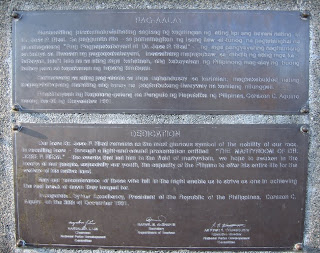
DEDICATION marker.

The execution site.

The Tagalog version.

Beside the entrance to the LIGHT and SOUND "museum" of Rizal's execution. Showing at 7pm everyday except Tuesdays.

On the left wall of the "museum", carved on marble tiles is the originally untitled last poem by Rizal.
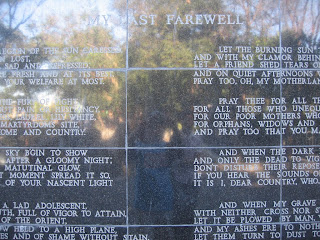
The English translation.
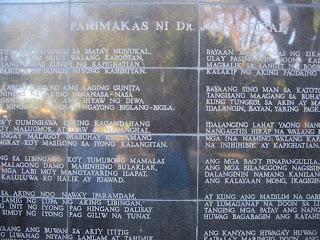
A poem wriiten by Andres Bonifacio himself dedicated to Rizal.

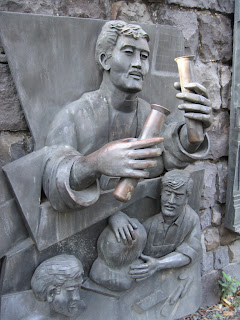
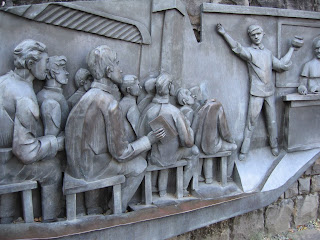
RELIEFS on Rizal's life, profession and contributions to society.


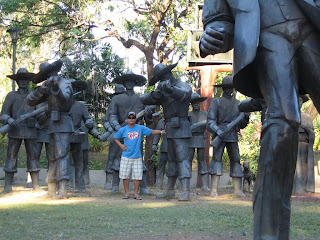
8-man Squad of Filipino Riflemen from the 70th Infantry Regiment: THE MAGALLANES


CONSUMMATUM EST (it is finished): The COMPLETION of a MARTYRDOM!


The RIZAL monument: built near the execution site of Bagumbayan, now Luneta.


Two guards in the post.

One of the members of the FIRING SQUAD - THE MAGALLANES, aiming the TARGET!

DEDICATION marker.

The execution site.

The Tagalog version.

Beside the entrance to the LIGHT and SOUND "museum" of Rizal's execution. Showing at 7pm everyday except Tuesdays.

On the left wall of the "museum", carved on marble tiles is the originally untitled last poem by Rizal.

The English translation.

A poem wriiten by Andres Bonifacio himself dedicated to Rizal.

RELIEFS on Rizal's life, profession and contributions to society.


8-man Squad of Filipino Riflemen from the 70th Infantry Regiment: THE MAGALLANES


CONSUMMATUM EST (it is finished): The COMPLETION of a MARTYRDOM!


The RIZAL monument: built near the execution site of Bagumbayan, now Luneta.


Two guards in the post.
Wednesday, February 3, 2010
EL FILIBUSTERISMO
source: http://joserizal.ph
The word "filibustero" wrote Rizal to his friend, Ferdinand Blumentritt, is very little known in the Philippines. The masses do not know it yet.
Jose Alejandro, one of the new Filipinos who had been quite intimate with Rizal, said, "in writing the Noli Rizal signed his own death warrant." Subsequent events, after the fate of the Noli was sealed by the Spanish authorities, prompted Rizal to write the continuation of his first novel. He confessed, however, that regretted very much having killed Elias instead of Ibarra, reasoning that when he published the Noli his health was very much broken, and was very unsure of being able to write the continuation and speak of a revolution.
Explaining to Marcelo H. del Pilar his inability to contribute articles to the La Solidaridad, Rizal said that he was haunted by certain sad presentiments, and that he had been dreaming almost every night of dead relatives and friends a few days before his 29th birthday, that is why he wanted to finish the second part of the Noli at all costs.
Consequently, as expected of a determined character, Rizal apparently went in writing, for to his friend, Blumentritt, he wrote on March 29, 1891: "I have finished my book. Ah! I’ve not written it with any idea of vengeance against my enemies, but only for the good of those who suffer and for the rights of Tagalog humanity, although brown and not good-looking."
To a Filipino friend in Hong Kong, Jose Basa, Rizal likewise eagerly announced the completion of his second novel. Having moved to Ghent to have the book published at cheaper cost, Rizal once more wrote his friend, Basa, in Hongkong on July 9, 1891: "I am not sailing at once, because I am now printing the second part of the Noli here, as you may see from the enclosed pages. I prefer to publish it in some other way before leaving Europe, for it seemed to me a pity not to do so. For the past three months I have not received a single centavo, so I have pawned all that I have in order to publish this book. I will continue publishing it as long as I can; and when there is nothing to pawn I will stop and return to be at your side."
Inevitably, Rizal’s next letter to Basa contained the tragic news of the suspension of the printing of the sequel to his first novel due to lack of funds, forcing him to stop and leave the book half-way. "It is a pity," he wrote Basa, "because it seems to me that this second part is more important than the first, and if I do not finish it here, it will never be finished."
Fortunately, Rizal was not to remain in despair for long. A compatriot, Valentin Ventura, learned of Rizal’s predicament. He offered him financial assistance. Even then Rizal’s was forced to shorten the novel quite drastically, leaving only thirty-eight chapters compared to the sixty-four chapters of the first novel.
Rizal moved to Ghent, and writes Jose Alejandro. The sequel to Rizal’s Noli came off the press by the middle of September, 1891.On the 18th he sent Basa two copies, and Valentin Ventura the original manuscript and an autographed printed copy.
Inspired by what the word filibustero connoted in relation to the circumstances obtaining in his time, and his spirits dampened by the tragic execution of the three martyred priests, Rizal aptly titled the second part of the Noli Me Tangere, El Filibusterismo. In veneration of the three priests, he dedicated the book to them.
"To the memory of the priests, Don Mariano Gomez (85 years old), Don Jose Burgos (30 years old), and Don Jacinto Zamora (35 years old). Executed in the Bagumbayan Field on the 28th of February, 1872."
"The church, by refusing to degrade you, has placed in doubt the crime that has been imputed to you; the Government, by surrounding your trials with mystery and shadows causes the belief that there was some error, committed in fatal moments; and all the Philippines, by worshipping your memory and calling you martyrs, in no sense recognizes your culpability. In so far, therefore, as your complicity in the Cavite Mutiny is not clearly proved, as you may or may not have been patriots, and as you may or may not cherished sentiments for justice and for liberty, I have the right to dedicate my work to you as victims of the evil which I undertake to combat. And while we await expectantly upon Spain some day to restore your good name and cease to be answerable for your death, let these pages serve as a tardy wreath of dried leaves over one who without clear proofs attacks your memory stains his hands in your blood."
Rizal’s memory seemed to have failed him, though, for Father Gomez was then 73 not 85, Father Burgos 35 not 30 Father Zamora 37 not 35; and the date of execution 17th not 28th.
The FOREWORD of the Fili was addressed to his beloved countrymen, thus:
"TO THE FILIPINO PEOPLE AND THEIR GOVERNMENT"
El Filibusterismo: Mga Tauhan
Ang nobelang "El Filibusterismo" ay isinulat ng ating magiting na bayaning si Dr. Jose Rizal na buong pusong inalay sa tatlong paring martir, na lalong kilala sa bansag na GOMBURZA - Gomez, Burgos, Zamora.
Tulad ng "Noli Me Tangere", ang may-akda ay dumanas ng hirap habang isinusulat ito. Sinimulan niyang isulat ito sa London, Inglatera noong 1890 at ang malaking bahagi nito ay naisulat niya sa Bruselas, Belgica. Natapos ang kanyang akda noong Marso 29, 1891. Isang Nagngangalang Valentin Viola na isa niyang kaibigan ang nagpahiram ng pera sa kanya upang maipalimbag ang aklat noong Setyembre 22, 1891.
Ang nasabing nobela ay pampulitika na nagpapadama, nagpapahiwatig at nagpapagising pang lalo sa maalab na hangaring makapagtamo ng tunay na kalayaan at karapatan ang bayan.
Mga Tauhan:
Simoun
Ang mapagpanggap na mag-aalahas na nakasalaming may kulay
Isagani
Ang makatang kasintahan ni Paulita
Basilio
Ang mag-aaral ng medisina at kasintahan ni Juli
Kabesang Tales
Ang naghahangad ng karapatan sa pagmamay- ari ng lupang sinasaka na inaangkin ng mga prayle
Tandang Selo
Ama ni Kabesang Tales na nabaril ng kanyang sariling apo
Ginoong Pasta
Ang tagapayo ng mga prayle sa mga suliraning legal
Ben-zayb
Ang mamamahayag sa pahayagan
Placido Penitente
Ang mag-aaral na nawalan ng ganang mag-aral sanhi ng suliraning pampaaralan
Padre Camorra
Ang mukhang artilyerong pari
Padre Fernandez
Ang paring Dominikong may malayang paninindigan
Padre Florentino
Ang amain ni Isagani
Don Custodio
Ang kilala sa tawag na Buena Tinta
Padre Irene
Ang kaanib ng mga kabataan sa pagtatatag ng Akademya ng Wikang Kastila
Juanito Pelaez
Ang mag-aaral na kinagigiliwan ng mga propesor; nabibilang sa kilalang angkang may dugong Kastila
Makaraig
Ang mayamang mag-aaral na masigasig na nakikipaglaban para sa pagtatatag ng Akademya ng Wikang Kastila ngunit biglang nawala sa oras ng kagipitan.
Sandoval
Ang kawaning Kastila na sang-ayon o panig sa ipinaglalaban ng mga mag-aaral
Donya Victorina
Ang mapagpanggap na isang Europea ngunit isa namang Pilipina; tiyahin ni Paulita
Paulita Gomez
Kasintahan ni Isagani ngunit nagpakasal kay Juanito Pelaez
Quiroga
Isang mangangalakal na Intsik na nais magkaroon ng konsulado sa Pilipinas
Juli
Anak ni Kabesang Tales at katipan naman ni Basilio
Hermana Bali
Naghimok kay Juli upang humingi ng tulong kay Padre Camorra
Hermana Penchang
Ang mayaman at madasaling babae na pinaglilingkuran ni Juli
Ginoong Leeds
Ang misteryosong Amerikanong nagtatanghal sa perya
Imuthis
Ang mahiwagang ulo sa palabas ni G. Leeds
Subscribe to:
Posts (Atom)